Many patients hear the terms histology and biopsy used interchangeably and naturally assume they mean the same thing. This leads to a common question: is histology the same as a biopsy?
While these two terms are closely connected, they are not the same. They describe different steps of the same diagnostic process. Understanding the difference helps patients feel more informed, reassured, and confident about their care.
This guide explains clearly what a biopsy is, what histology is, how they work together, and why both are essential in modern medical diagnosis.
What Is a Biopsy?
A biopsy is a medical procedure in which a small sample of tissue is taken from the body for further examination. This tissue may be taken from the skin, a lump, a cyst, a mole, or an internal organ.
The purpose of a biopsy is to collect tissue so doctors can determine whether the cells are normal, inflamed, infected, or abnormal.
A biopsy can be performed using different techniques depending on the area and size of the lesion, including:
Skin punch biopsy
Shave biopsy
Excision biopsy
Needle biopsy
Surgical biopsy
The biopsy itself is the act of removing the tissue.
What Is Histology?
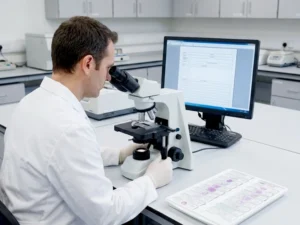
Histology is the laboratory examination of the tissue after it has been removed during a biopsy or minor surgery.
Once the tissue sample is collected, it is preserved and sent to an accredited laboratory, where specialist doctors known as pathologists examine it under a microscope.
Histology allows doctors to study:
→ Cell structure
→ Tissue patterns
→ Signs of inflammation
→ Abnormal cell growth
→ Cancerous changes
Histology is the analysis stage, not the removal stage.
Is Histology the Same as a Biopsy?
No, histology and biopsy are two different parts of the same diagnostic process.
A biopsy is the procedure used to remove tissue.
Histology is the laboratory examination of tissue.
Simply put:
You have a biopsy, and the tissue undergoes histology testing.
How Do Biopsy and Histology Work Together?
The diagnostic journey often follows this sequence:
→ A doctor identifies a suspicious lesion or lump.
→ A biopsy is performed to remove a tissue sample.
→ The sample is preserved and sent to a laboratory.
→ Histology is carried out to examine the tissue under a microscope.
→ A report is produced with diagnostic findings.
Both steps are essential. Without the biopsy, there is no tissue to examine. Without histology, the biopsy sample cannot be accurately diagnosed.
Why Are Both Important?
Together, biopsy and histology allow doctors to:
→ Confirm diagnosis
→ Rule out cancer
→ Identify infection or inflammation
→ Plan appropriate treatment
→ Provide patient reassurance
This combination ensures accuracy, safety, and early detection when needed.
When Is a Biopsy Recommended?
A biopsy may be recommended if:
→ A mole changes colour, shape or size
→ A lump grows or becomes painful
→ A cyst repeatedly returns
→ A lesion bleeds, crusts or ulcerates
→ There is suspicion of abnormal tissue
In these cases, biopsy followed by histology ensures accurate diagnosis.
What Happens During a Skin Biopsy?
For skin biopsies, the area is cleaned and numbed using a local anaesthetic. A small sample of tissue is removed using a sterile technique. The wound is then dressed, and aftercare instructions are provided.
The sample is preserved and sent for histology analysis.
How Long Do Histology Results Take After a Biopsy?
In the UK, histology results typically take 7 to 14 days, depending on sample complexity and laboratory workload.
If urgent testing is required, results may be prioritised and returned sooner.
What Do Histology Results Show?
Histology can confirm whether tissue is:
→ Normal
→ Benign
→ Inflamed
→ Infected
→ Pre-cancerous
→ Cancerous
This allows clinicians to determine whether further treatment, monitoring, or referral is needed.
Should You Be Worried If You Need a Biopsy?
Most biopsies do not reveal cancer. Many are performed simply to rule out serious conditions and provide peace of mind.
Biopsy and histology are precautionary tools that help ensure accurate diagnosis and patient safety.
Histology & Biopsy at Pinnacle Clinic Keighley
At Pinnacle Clinic Keighley, biopsies and tissue sampling are performed using sterile techniques by qualified doctors. All samples are sent to accredited UK laboratories for reliable histology analysis. Results are explained clearly, with full guidance and reassurance provided throughout the process.
Conclusion
So, is histology the same as a biopsy?
No. A biopsy is the procedure used to remove tissue, while histology is the laboratory examination of that tissue. Together, they form a vital diagnostic pathway that ensures accurate diagnosis, early detection and patient peace of mind.